Showing posts with label mooooovies. Show all posts

Wednesday, June 17, 2015

Akira, Shakespeare, Whitewashing, and Racebending

The triannual threat from Hollywood to make a live-action Akira movie has once again reared its ugly head. In years past, it's always been made very clear that they intend to make an "American" version with an entirely white cast. This is, of course, horrible. Akira is a deeply Japanese manga. The culture described is based very firmly in Japanese youth culture of the era in which it was written. The plot is a reflection of cultural memory of the atomic bombings at Hiroshima and Nagasaki. Translating it into American culture is deeply problematic and difficult, and that's even assuming anyone involved gives even the slightest shit about doing any more than saying "It's set in Manhattan now, and everyone's white." Which is what's going to happen if this abomination ever gets made (it won't.)

But one of the arguments I see people make in favor of that treatment (and, horrifically, they exist) is that cultures all over the world get to do their own version of Shakespeare! That's something that's ours, as white people, dammit, why do they get to do it?

Oh my goodness, what an argument. Let's put aside the issue of cultural appropriation and its intrinsic ties to power differentials and colonialism- that colonialism impresses its own culture on other people's by choice and then steals from them by force and hegemonic pressure. I mean, that's a really big elephant to put aside, but I'm not the best at discussing that and it's not a topic people who would be making the Shakespeare argument would even believe in anyway.

I am, however, pretty good at discussing history, and motherfucker you just put Shakespeare and race in the same discussion so yes, let's discuss that.

There's two Shakespearean plays where a person of color is a prominent, even titular, protagonist: Antony and Cleopatra, and Othello. Of the two, Othello is the more interesting and is widely celebrated as one of his best tragedies. The 1965 film version is the single most critically rewarded film adaptation of a Shakespearean play. It's survived largely unchanged for over 400 years.

In it, Othello is a Moorish captain in Venice, in love with an Italian woman, while forces conspire to keep them apart, succeeding in tragic fashion (spoiler alert). Themes of racial and cultural divides are central to the story. Othello's actual racial identity is much debated, as the Moors were a very cosmopolitan people in Elizabethean times. Some contend he was of Arabic descent, others say he was of sub-Saharan descent- in any case he was certainly a person of color.

It probably goes without saying that Shakespeare did not actually cast a Moor as Othello. His players were 100% white English dudes, including the women (basically, they were Monty Python.) There's some debate as to whether Shakespeare had ever even met a Moor. So, naturally it was played in blackface. In fact, an actor of color did not play Othello until 1826- 261 years after it was written. Richard Burbage took the stage to play the Moor in London and his presence was about as well received as you can imagine:
Unsurprisingly given the times, there was considerable resistance to the presence of the world's first black Othello. Eighteenth century London was the epicentre of Britain's pro-slavery lobby, and the press conducted a campaign of blatant racism against him. In one of his two Othello performances at the Covent Garden theatre in 1833, The Atheneum objected to actress Ellen Tree as Desdemona, being "pawed about on the stage by a black man." The Times newspaper had been just as scathing eight years prior, when it commented that, "Owing to the shape of his lips it is utterly impossible for him to pronounce English."
Of course, this was England, where racial issues were certainly present, but not quite a fraught as in America.  In fact, in America, a racially correct Othello wasn't seen until 100 years later in 1943, when Paul Robeson played the character.

And then, we come to Hollywood. You'd think, okay, the first black film actor to play Othello couldn't have come too long after the first American stage actor. Oh, gosh, you would think huh?

1995. Laurence Fishburne. That wildly celebrated 1965 version I mentioned earlier? Sir Lawrence Olivier in blackface. In Nineteen. Sixty. Goddamn. Five. That's only 50 years ago and he was nominated for an Oscar for his blackface.

So yeah. Let's goddamn bring Shakespeare into the race conversation, because it's not really helping the "WOO WHITE PEOPLE" side over here.


In more positive news, Neil Gaiman's American Gods is being adapted for TV by Bryan Fuller (creator of Dead Like Me, Pushing Daisies, and Hannibal). Production is starting as soon as they cast the protagonist- Shadow.

Like Othello, Shadow is described as having dark skin- certainly a person of color. He is however, left very racially ambiguous. Many people assume he's black, other people picture a more Hispanic character- I feel like he probably looks racially ambiguous, owing to the themes of America's role in taking the cultures and gods of immigrants and stripping them away into nothingness, forcing them to leave behind their identity.

At any rate, Fuller had this to say about casting him:
I think if we cast a white man to play Shadow we would be the biggest assholes on television...
One of the things I’m most excited about for American Gods is the diversity in the cast because there’s such a wide range of ethnic Gods in the world. Right now, we’re imagining two white roles and everybody else is non-white, so my goal, Michael’s goal, certainly Neil’s goal has been to have a very ethnically diverse cast. That’s important to all of us.
Right. On.

Friday, May 22, 2015

A Second Chance for Diversity

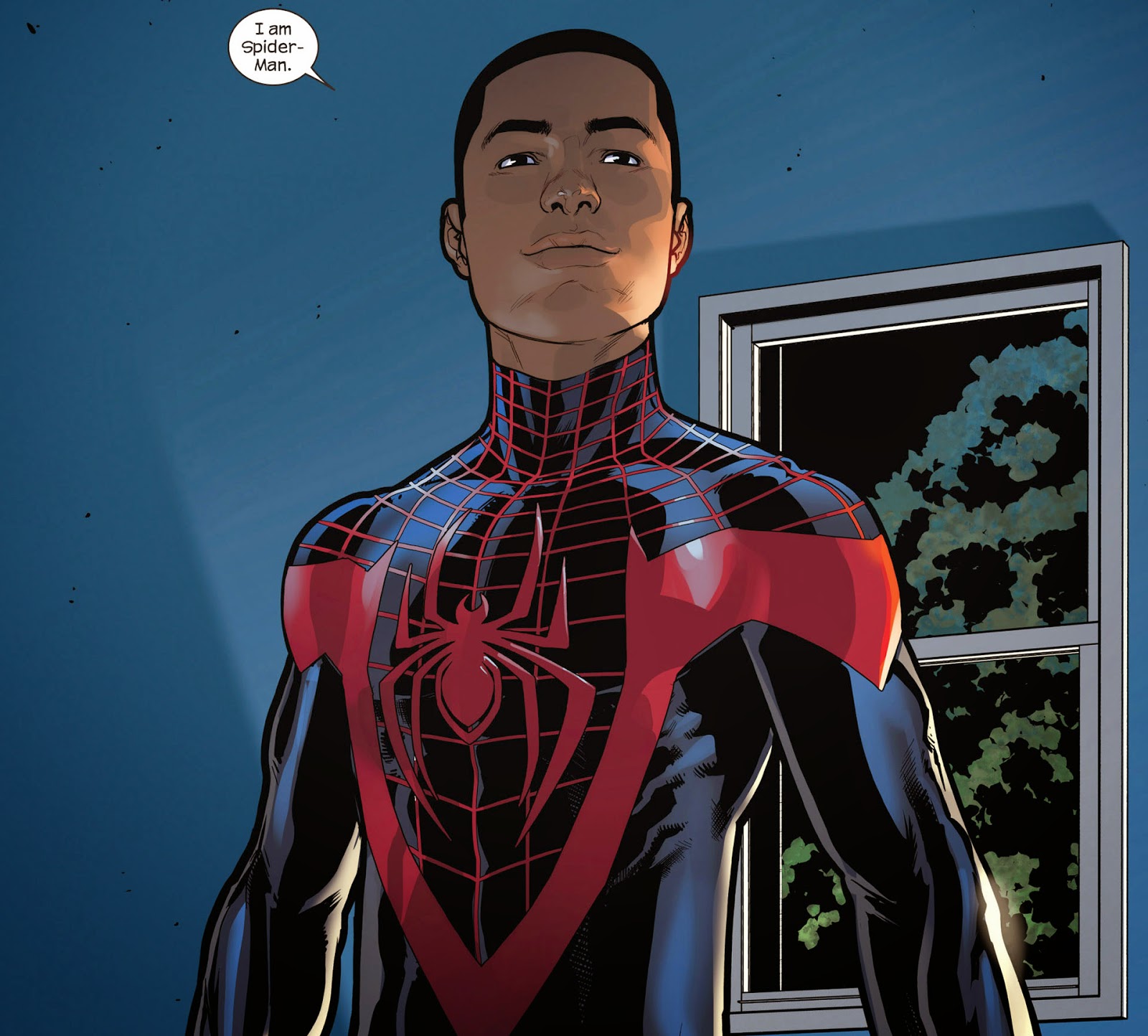
Back in 2010 a social media grassroots campaign formed around the fact that Sony was rebooting the Spider-Man franchise. The idea: why not cast Donald Glover as Peter Parker? After all, the defining features of Peter are that he's smart, a bit of a nerd, but wise-cracking and fun. He grew up in a working class neighborhood in New York City, an orphan raised by his aunt and uncle. Also, he got bit by a scientifically improbable spider. Nothing about the character was defined by his skin color- he was white because he was created by white dudes in the early 60s, but that description could easily fit someone of pretty much any race- after all, it's NYC.

In fact, that issue is something that has plagued comics. It was 40 years before Batman had a recurring black supporting character. Shakespeare's works have more prominent people of color than the original Justice League (or, for that matter, the current Justice League too.) The origins of nearly all popular comics come from a time where it was literally unthinkable to make a main character anything but white- simply put no one thought of it. Yet those characters and stories have endured for nearly 80 years in some cases and, while we live in an era where it's okay to reimagine Hamlet as a lion, it's not okay to reimagine Peter Parker as black.

Except while the Peter Parker campaign failed, not everyone in Hollywood is pushing against it. On The Flash, Iris West (pretty much originally conceived as "Hey, The Flash needs a Lois Lane") is played by Candice Patton. On the upcoming Supergirl show, Jimmy Olson is going to be played by Mehcad Brooks. We've seen our first glimpse of the new Hawkgirl in the season finale of the Flash- the Earth 2 version of Kendra Saunders, now represented by Ciara Renee. The (awesome) DC TV universe isn't the only place this is happening, either. Ben Urich in Daredevil was played by Vondie Curtis-Hall (brilliantly). Ultimate Nick Fury has been the MCU's most constant companion, and they very pointedly chose to pretty much make the Sam Jackson version the canon Nick Fury across all of their properties.

Meanwhile, canon characters of color are being raised to greater prominence. Age of Ultron ended with Falcon and War Machine being part of the New Avengers. On Flash, Cisco Ramon (who was considered so offensively stereotypical in his original comic incarnation that artist George Perez refused to draw him) is a main character and extremely well liked by fans. Agents of SHIELD brought Daisy Johnson front and center.

It represents an attempt to say "Hey, for whatever reason (racism) these stories were completely white the first time they were told. Let's try again." And while it's far from perfect (notice how no one mentioned is the main character), it's better. It's an admission that the original stories came from a worse time for a lot of people- and that adapting them to a new medium means we can do better this time around.

And, in turn, comics have started to try- at least Marvel has. The current comic Avengers include Ms. Marvel (aka Kamala Khan, a Pakistani-American from New Jersey), Nova (aka Sam Alexander, a Latino teenager from Arizona), and Miles Morales- the Ultimate Spider-Man inspired by the campaign to make Donald Glover Spider-Man.

Sunday, September 15, 2013

Trans- Post

1) Listening to a podcast I'd never listened to today, Sklarbro Country, they had a comedian, Will Weldon, and asked him what his current favorite joke is in his set. His response is that he has a bit about movies and their treatment of transgender people and how much he hates when a straight male character finds out someone they were interested in used to be a man and they you get the smash cut to them vomiting (see also: the entire climax of Ace Ventura). His fantastic comment: "you know, every girl you've been with used to be a child. Are you gonna freak out that you're a pedophile now?" I was just super surprised to hear about this comedian's perspective on that and that it was his current favorite thing to rant about on stage. Love it. Need to find more of his work.

2) I watched Kinky Boots last night. It's a somewhat-true story of a dude who inherits a failing men's shoes business and, after attempting to save a drag queen being attacked in an alley, is inspired to refocus his factory into making shoes for drag queens. It's pretty decent and actually reasonably respectful of trans people, though perhaps oversexualized as the treatment often is. Still, I have to talk about Chiwetel Ejiofor's performance as Lola, which was just...really amazingly good. A lot of movies about transvestite or transgender people try to make the person in question look uncomfortable or awkward in their chosen gender performance, but Ejiofor just does the exact opposite. He looks so comfortable and at ease as Lola and doesn't miss a beat when dressed as her. It's when Lola is forced to dress down into a man that he does a great job looking very uncomfortable and off somehow. She is Lola, not Simon, and being forced to be Simon is not okay to her. It's really great.

Also, just small bonus points to the movie for having the characters refer to her in the feminine even when she's not dressed up. Just seems right.

And I just learned that it's now a Tony winning Broadway musical and how the hell did I miss that this year? Do want.

Monday, May 20, 2013

Men Boldly Going


So Felicia Day made a(spoilery) post about the lack of strong women in Star Trek Into Darkness and, oh happy coincidence, I just saw it yesterday so I can take a stand and say.

She’s totally right. Shocking. So I’m just gonna springboard that into my mostly non-spoilery take.

There are two prominent, named female characters in the movie, Uhura and Alice Eve’s character (who shall remain nameless because minor spoilers). If you guessed that they never even meet each other throughout the movie, you just win every prize ever. That’s hardly the tip of the problem though.

In the first movie, we got Uhura and Spock’s relationship thrust into the narrative. Mr. Plinkett (a reviewer who is really on target with his criticisms, but his framing device is just godawful indefensibly terrible) called this a case of the “Not Gays” pointing out that every single male character in the movie made some reference to women. The “Not Gays” were significantly reduced in this movie to just Kirk (because Kirk) and Spock, because Uhura, and I hope that’s because maybe it’s pretty inappropriate to make everyone on board the Enterprise heterosexual when you’ve got two prominent Star Trek cast members who are gay, including George Fucking Takei? Maybe that’s not cool?

Anyway, whatever. The new issue is that, if you didn’t know, Uhura never needed to have a relationship with a man to be an interesting and sympathetic character in the original series or movies. She flirted on occasion but it was not a defining characteristic of her character. In this movie? She’s all about the Spock relationship. She gets maybe one pretty decent scene divorced from the relationship, otherwise? Nope. Spock. Spock Spock Spock.

Meanwhile, in the original universe, Alice Eve’s character was a brilliant scientist, one of the best in the Federation, who stood up to Starfleet. In this one, she’s eye candy and victim. She is there to be tortured and saved and occasionally half-naked.

When you’re moving backwards from the 1970s, you really need to re-evaluate your writing.

There was one helms officer that I noticed, played by Aisha Hinds, and I thought that was fairly interesting. She was mostly relegated to the sides of the screen and had one line. The weird android guy got a close-up and more lines, while she didn’t. Bleh.

So yeah, I mean. Star Trek was created in the 1960s. It was prominently about men, especially the core trio of Spock, Kirk, and Bones. But it’s 2013 and it’s a rebooted franchise. It’s not wrong to expect more and expect better.

Anyway, as a summer blockbuster, it wasn’t a bad movie. It was better than the first movie, I think, a bit more Star Trek-y, and I did genuinely enjoy it. Just…eh. Eh.